
Natural sunlight can transform an interior. It makes spaces feel open, helps colors appear more vivid, and creates visual variation throughout the day. Unfortunately, many offices, schools, healthcare environments, retail stores, and other commercial buildings cannot provide consistent daylight to every occupied area.
A thoughtfully designed natural light LED system can help fill those gaps.
Although electric lighting cannot replace the full biological or environmental qualities of the sun, modern LED technology can reproduce many of the visual characteristics people associate with daylight. The right combination of color quality, correlated color temperature, light distribution, controls, and architectural integration can make an interior feel brighter, more comfortable, and more connected to the outdoors.
At Goldeneye Lighting, we approach this challenge differently. Our patented Airelight® platform uses fully ceramic LED technology designed and manufactured in Carlsbad, California. By eliminating plastic from the fixture and rethinking the light source at a materials level, we provide architects, designers, contractors, and building owners with a sustainable alternative to conventional commodity LED products.
Planning a commercial lighting project? Request a quote or add Goldeneye Lighting to your bid list, call 877.298.0092, or email info@goldeneyelighting.com.
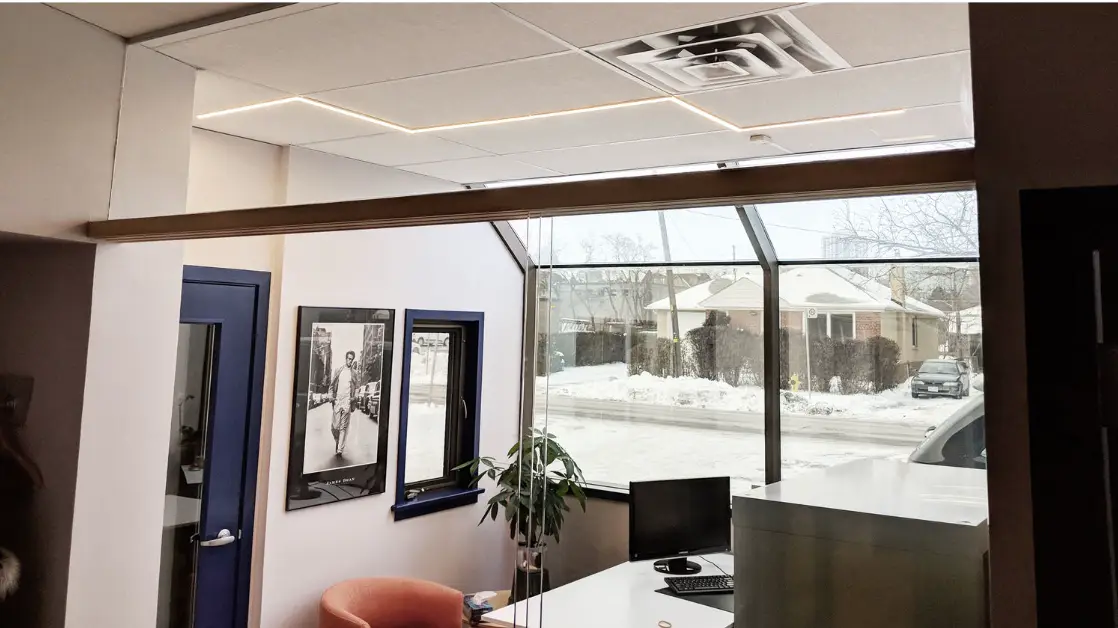 Airelight™ Linear SC 1.0 Directly Attached to T Bar Grid
Why Natural Sunlight Matters in Commercial Interiors
Daylight does more than illuminate a room. It changes in intensity, direction, and color throughout the day, helping indoor environments feel dynamic rather than visually flat.
Research has also found associations between workplace daylight exposure and outcomes such as sleep duration, sleep quality, and perceived well-being. However, these findings should not be interpreted to mean that an LED fixture provides every health benefit of direct sunlight.
For example, LEDs do not produce vitamin D in the body. Vitamin D synthesis depends on ultraviolet B exposure, while quality architectural LED systems are designed primarily to provide safe, visible illumination. Electric lighting should therefore complement daylight—not be marketed as a medical substitute for it.
From an architectural perspective, access to natural sunlight may contribute to:
- A stronger visual connection with the outdoors
- More engaging and comfortable interiors
- Better perception of materials, finishes, merchandise, and artwork
- Reduced dependence on electric lighting when daylight controls are used
- A more appealing experience for employees, customers, students, and visitors
The challenge is that daylight is not evenly available. Interior rooms, lower floors, deep floor plates, enclosed corridors, and windowless spaces may receive little or no direct daylight. Even perimeter spaces experience changing conditions caused by time of day, season, weather, window orientation, and shading.
That is where a coordinated daylight and LED strategy becomes valuable.
What Is Natural Light LED Lighting?
Natural light LED lighting is electric illumination designed to produce visual qualities associated with daylight. This usually involves more than selecting a fixture labeled “daylight.”
A successful system considers several connected factors:
- Color temperature: The apparent warmth or coolness of white light, expressed in kelvins
- Color rendition: How accurately and naturally colors appear under the light source
- Intensity: The amount of light reaching a surface
- Distribution: How illumination moves through the room and interacts with ceilings and walls
- Glare control: Protection against excessive brightness and uncomfortable contrast
- Dimming and controls: The ability to adapt light levels to occupancy, available daylight, and different tasks
- Architectural integration: How the luminaires fit within ceilings, walls, acoustic systems, and the overall design
A fixture with a high color temperature is not automatically the best daylight solution. Likewise, selecting the brightest available product does not guarantee a natural or comfortable result.
The objective is to balance color, brightness, distribution, and control around the needs of the occupants and the architecture.
Can LED Lighting Simulate Sunlight?
LED technology can reproduce certain visible characteristics of sunlight, but it cannot duplicate the sun in every respect.
A well-designed light that simulates sunlight may provide a daylight-like white appearance, reveal colors accurately, deliver broad ambient illumination, and change in response to the time of day or available daylight. It does not reproduce the sun’s complete spectrum, ultraviolet exposure, heat, direction, or outdoor experience.
This distinction is important for responsible lighting specifications. Rather than promising that an artificial source is identical to the sun, project teams should identify the daylight qualities most important for the space.
Color Temperature and the Appearance of Daylight
Correlated color temperature, or CCT, describes whether white light appears warm, neutral, or cool.
Common ranges include:
- 2700K–3000K: Warm, relaxed illumination
- 3500K: Balanced, neutral-white light
- 4000K: Crisp white illumination frequently used in commercial environments
- 5000K and above: Cooler light commonly associated with daylight-like applications
Sunlight does not have one fixed color temperature. Its appearance changes according to time, weather, location, and atmospheric conditions. For that reason, simply specifying 5000K throughout an entire building will not necessarily create the most natural environment.
A workplace may benefit from neutral or cooler light during active daytime hours, while hospitality or lounge areas may call for warmer illumination. The appropriate CCT should always reflect the application, finishes, design intent, and occupant needs.
Color Rendition Matters as Much as CCT
Color Rendering Index, or CRI, is a familiar way to compare how faithfully a light source renders colors relative to a reference source. Higher-quality color rendition can help skin tones, textiles, artwork, merchandise, food, and interior finishes look more recognizable and appealing.
CRI alone does not describe every aspect of color quality. The Illuminating Engineering Society’s TM-30 method offers additional information about color fidelity and gamut, giving lighting professionals a more complete tool for comparing sources.
When evaluating a daylight-inspired lighting system, ask for more than the CCT printed on a specification sheet. Consider CRI, R9, TM-30 data when available, color consistency, glare, distribution, and performance over time.
Contact Goldeneye Lighting to discuss the requirements of your next architectural lighting project.
LED Bulbs, Natural Light, and Integrated Commercial Luminaires
People frequently search for LED bulbs natural light when they want a room to feel brighter or more like daylight. For a table lamp or basic residential retrofit, a replacement bulb may be sufficient. Commercial architectural projects, however, require a more complete approach.
An individual bulb cannot solve poor fixture placement, harsh glare, uneven illumination, incompatible controls, or inadequate light levels. It also may not integrate cleanly with ceilings, walls, acoustic products, or custom architectural details.
Integrated luminaires allow the project team to coordinate:
- Fixture spacing and orientation
- Delivered light levels
- Beam distribution
- Surface brightness
- Dimming behavior
- Control compatibility
- Thermal performance
- Visual continuity
- Mounting and structural requirements
Goldeneye Lighting’s Airelight® platform is designed for architectural integration rather than mass-market bulb replacement. Its low-profile ceramic construction can support clean integration into ceiling, wall, linear, and acoustic applications while giving designers an alternative to conventional plastic-dependent fixtures.
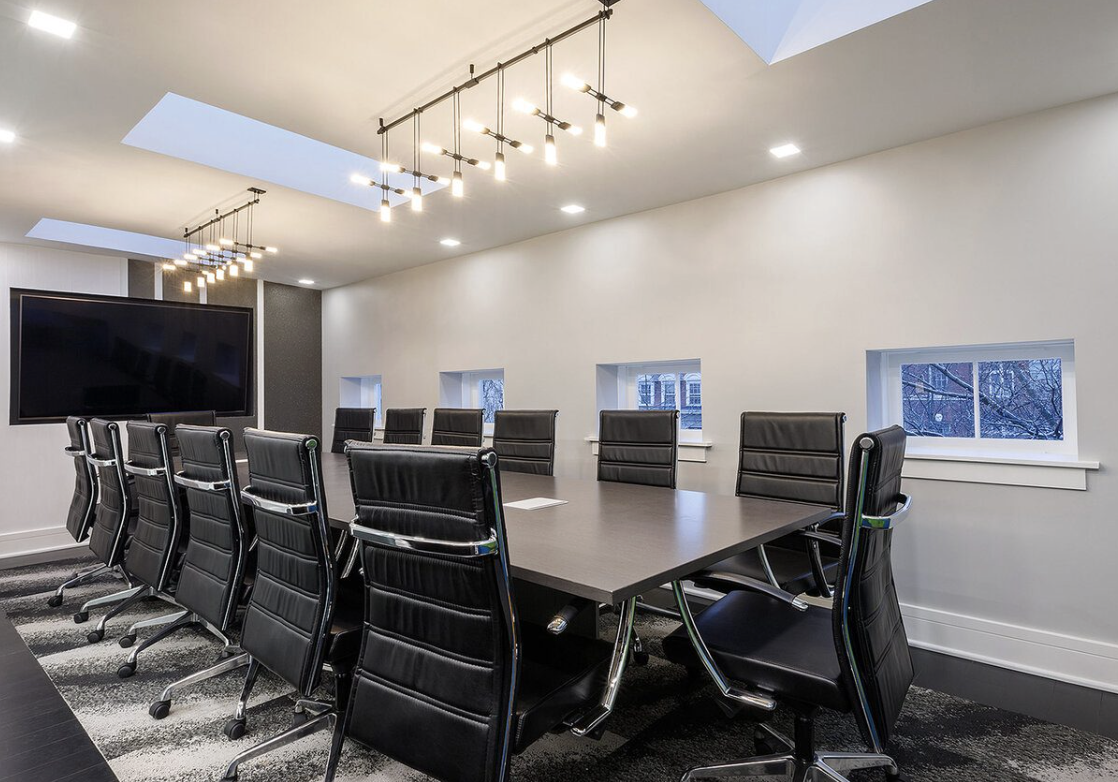
Airelight™ Square 4.0 Installed with Mud In Trim Kit
How to Combine Daylight and LED Lighting
The most effective approach is usually not sunlight versus LED lighting. It is a coordinated system in which electric light supports the building whenever daylight is unavailable or insufficient.
Start With the Available Daylight
Evaluate windows, skylights, glass partitions, room depth, surface reflectance, exterior obstructions, and the building’s orientation. Daylight should be treated as a changing resource rather than a constant light source.
Whenever possible:
- Keep tall furniture away from windows
- Use interior glazing to share daylight between spaces
- Choose finishes that distribute light without creating excessive glare
- Position regularly occupied areas where they can benefit from exterior views
- Use shading to control direct sun and heat gain
Use Daylight Harvesting Controls
Daylight harvesting uses sensors and dimming controls to reduce electric light when sufficient daylight is available. As outdoor conditions change, the electric lighting can increase or decrease to maintain appropriate indoor illumination.
The U.S. Department of Energy identifies daylight-responsive controls as a way to reduce unnecessary electric-light use. Effective results depend on appropriate zoning, calibration, commissioning, and coordination with the fixture and control system.
A perimeter zone near windows should not necessarily operate at the same output as a windowless interior zone. Dividing the system into responsive control zones can improve both comfort and energy performance.
Add Occupancy, Vacancy, and Scheduling Controls
Additional strategies include:
- Occupancy sensors that activate or increase light when a space is used
- Vacancy controls that turn lights off after occupants leave
- Scheduling that reduces unnecessary after-hours operation
- Task tuning that sets appropriate illumination for specific activities
- Personal dimming that gives occupants greater control
- Scene controls for presentations, meetings, events, and cleaning
Controls should support the way people actually use the building. An overly complicated system that occupants cannot understand may undermine an otherwise strong lighting design.
Illuminate More Than the Workplane
A space can meet its target horizontal illuminance and still feel dim or uncomfortable. Illuminating ceilings and walls can improve perceived brightness, reduce visual contrast, and create a more open atmosphere.
Indirect or softly distributed illumination may help approximate the broad environmental brightness associated with daylight. Direct light can then provide the focused illumination required for desks, displays, counters, circulation areas, or other tasks.
Where Daylight-Inspired LED Lighting Works Best
Natural-looking illumination can benefit many commercial environments.
Offices and Collaborative Workplaces
Balanced ambient light can support computer work, meetings, circulation, and collaboration while reducing the visual contrast between bright windows and darker interior zones. Controls can adapt illumination as daylight changes throughout the workday.
Schools and Learning Environments
Classrooms need comfortable, flexible illumination for reading, writing, presentations, group activities, and art. Accurate color rendition and controllable light levels help the same room accommodate different learning tasks.
Retail and Showroom Spaces
Lighting influences how customers perceive products, finishes, and the store itself. High-quality color rendition can help merchandise look authentic, while integrated architectural lighting keeps attention on the products rather than bulky fixtures.
Healthcare and Wellness Environments
Healthcare lighting must address clinical tasks, patient comfort, wayfinding, cleaning, and around-the-clock operation. Light levels and color appearance should be selected with the project’s healthcare professionals and applicable standards rather than relying on generalized “sunlight” claims.
Hospitality and Public Spaces
Hotels, restaurants, lobbies, and gathering spaces often need lighting that changes between active daytime use and warmer evening experiences. Dimming and scene control can support those transitions without compromising the architecture.
A Different Approach to LED Lighting in San Diego
For firms seeking LED lighting San Diego expertise, Goldeneye Lighting offers the responsiveness of a local, U.S.-based manufacturer together with patented ceramic LED technology.
Our family-owned company designs and manufactures the Airelight® platform in Carlsbad, California. Domestic production allows for tighter quality oversight, responsive project support, and meaningful product differentiation in a market filled with similar-looking commodity fixtures.
The ceramic emitting surface also functions as part of the thermal solution, allowing Airelight® to operate without the plastic-heavy construction commonly found in conventional LED fixtures. This materials-first design supports low-profile architectural integration while reducing unnecessary material complexity.
Goldeneye Lighting offers project teams:
- Patented, fully ceramic LED technology
- Plastic-free fixture construction
- U.S.-based design and manufacturing
- Low-profile architectural integration
- Red List Free material options
- Recyclable, non-toxic material construction
- Lighting and acoustic integration options
- Direct access to knowledgeable project support
The result is not merely another daylight-colored LED. It is a fundamentally different platform for architects and designers who value material transparency, reliability, sustainable construction, and visual simplicity.
Project Highlight: Vertex Pharmaceuticals Biotech Facility
At the newly completed Vertex Pharmaceuticals biotech laboratory and research facility, Goldeneye Lighting demonstrates how high-performance illumination can become an integral part of the architecture.
Specified by DGA – Dowler Gruman Architects, Airelight™ Linear ES 1.0 LED Ceramic Luminaires were installed within channels embedded directly into the wood ceiling. The slim luminaires blend seamlessly into the warm material, creating bold, continuous lines of light without interrupting the space’s clean, modern aesthetic.
This thoughtfully integrated lighting concept delivers the required lumen output while allowing the architecture—not the fixture hardware—to remain the visual focus. The result is a refined commercial environment where precise illumination, natural materials, and contemporary design work together.
Project Details
- Project: Vertex Pharmaceuticals
- Specifier: DGA – Dowler Gruman Architects
- Application: Commercial biotech laboratory and research facility
- Installation: Embedded in wood
- Product: Airelight™ Linear ES 1.0 LED Ceramic Luminaires
This installation illustrates the design flexibility of Goldeneye’s ceramic LED technology. Airelight™ Linears can be incorporated into architectural materials and custom details to provide efficient, low-profile illumination in laboratories, offices, research facilities, and other sophisticated commercial interiors.
Designing a space that calls for seamless, architecturally integrated lighting? Request a quote or add Goldeneye Lighting to your bid list, call 877.298.0092, or email info@goldeneyelighting.com.
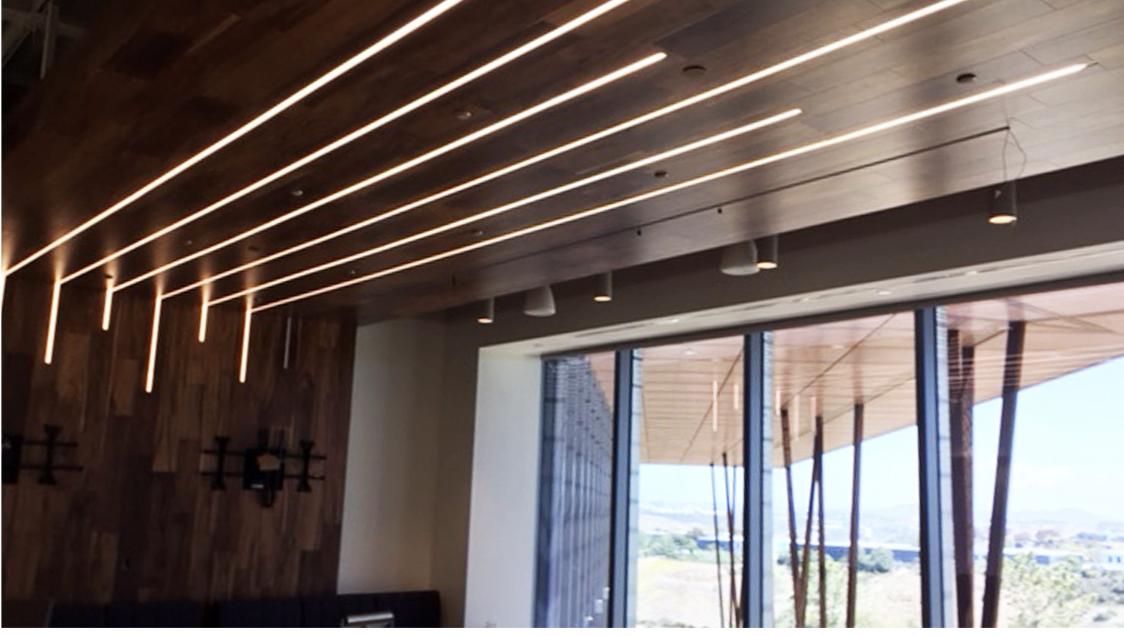
Airelight™ Linear ES 1.0 3500K Magnetically Attached to Embedded Channel with Diffuser
How to Specify a Natural Light LED System
Before selecting a product, establish the actual needs of the project. Useful questions include:
- How much daylight reaches each occupied zone?
- What activities take place in the space?
- Which materials or products require accurate color rendition?
- What CCT supports the architectural intent?
- How will glare be managed?
- Should the lighting dim or respond automatically to daylight?
- What ceiling, wall, or acoustic conditions affect integration?
- What sustainability or material-transparency goals apply?
- How will the system be commissioned and maintained?
- Can the manufacturer provide responsive specification and bid support?
Early collaboration can prevent fixture substitutions, control conflicts, awkward details, and inconsistent performance later in the project.
Bring Better Light to Your Next Project
The best daylight-inspired interiors begin with actual daylight whenever it is available. Carefully selected LED lighting can then provide consistent illumination, accurate color, visual comfort, and architectural continuity when natural light changes or disappears.
Goldeneye Lighting helps architects, designers, engineers, contractors, and owners move beyond commodity fixtures with a patented, fully ceramic lighting platform designed and manufactured in California.
If you are planning an office, school, retail, healthcare, hospitality, acoustic, or other commercial project, we would be glad to review the application.
Request a quote or add Goldeneye Lighting to your bid list, call 877.298.0092, or email info@goldeneyelighting.com.
Natural Light LED Frequently Asked Questions
Can LED lighting replace natural sunlight?
No. LED lighting can reproduce some of sunlight’s visible qualities, but it does not replace daylight, outdoor exposure, or the sun’s role in vitamin D synthesis. In commercial interiors, LED lighting works best as a complement to windows, skylights, and other daylight sources.
What LED color temperature looks most like daylight?
Many people associate 4000K to 5000K with daylight, but there is no single perfect setting because sunlight changes throughout the day. The best CCT depends on the space, finishes, activities, light levels, and desired atmosphere.
Is high CRI enough to make LED light look natural?
High CRI can support faithful color appearance, but it is only one part of lighting quality. Distribution, glare, intensity, color consistency, CCT, dimming, and TM-30 performance should also be considered.
What is daylight harvesting?
Daylight harvesting is a control strategy that dims or switches electric lighting in response to available daylight. When properly commissioned, it can reduce unnecessary energy use while maintaining suitable indoor light levels.
Does Goldeneye Lighting manufacture in the United States?
Yes. Goldeneye Lighting is a family-owned, U.S.-based manufacturer that designs and builds its patented Airelight® ceramic LED platform in Carlsbad, California.
How can I get Goldeneye Lighting included in a project?
Use our sales agent and quote request page, call 877.298.0092, or email info@goldeneyelighting.com to request product information, specification assistance, pricing, or bid-list inclusion.